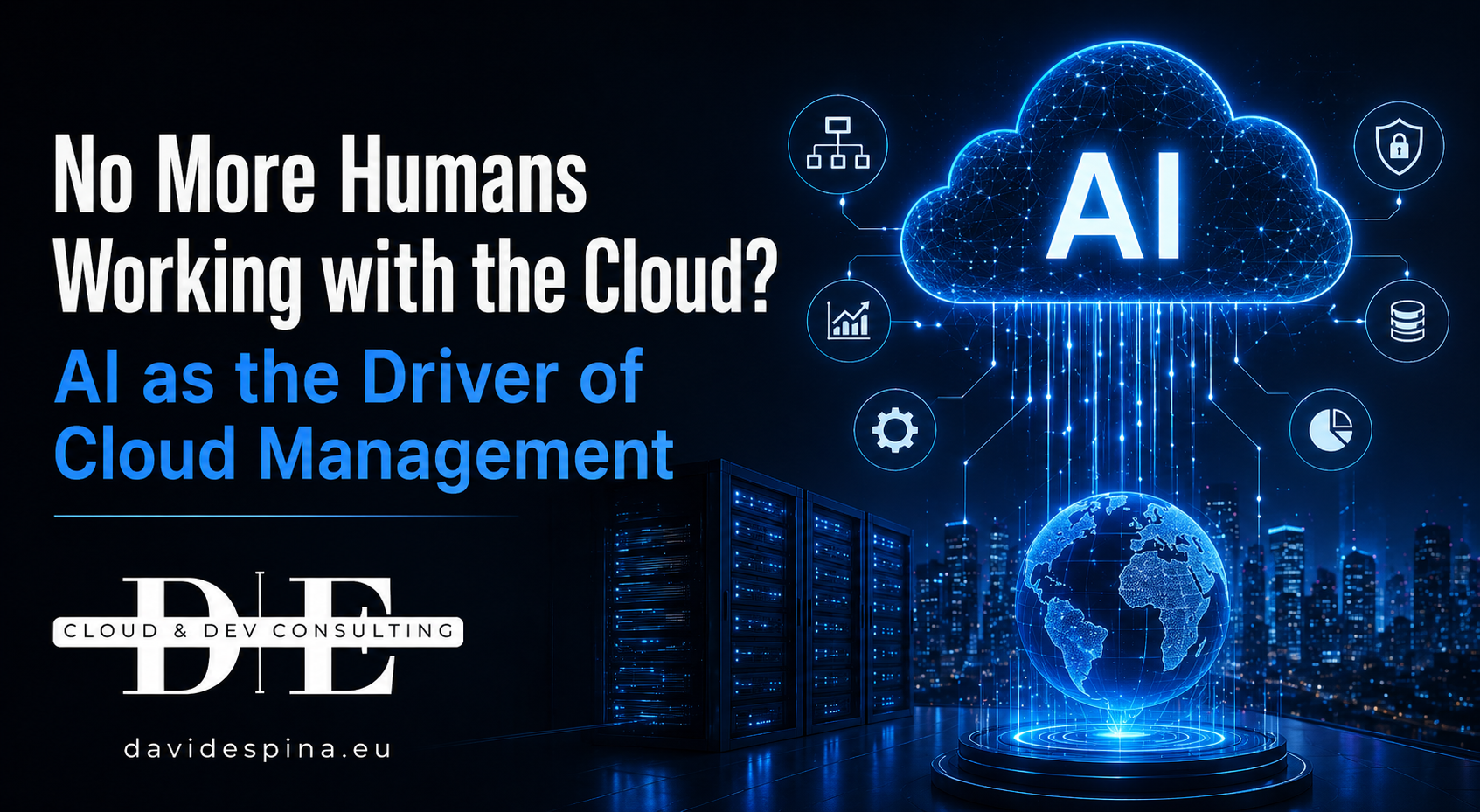
No More Humans Working with the Cloud? AI as the Driver of Cloud Management

Cloud computing is entering a new era defined by the deep integration of artificial intelligence (AI). Over the next decade, cloud platforms will evolve from simple infrastructure providers into autonomous, intelligent, and predictive ecosystems. AI will transform cloud operations management, optimize costs, automate processes, and enable more efficient and personalized services. This paper analyzes how AI will impact the cloud ecosystem, the dominant future trends, and the long-term market projections for AI-powered cloud computing.
1. Introduction
Since its emergence, cloud computing has revolutionized the way organizations consume technological infrastructure. However, the exponential growth of data, distributed applications, and digital services has generated operational complexity that increasingly exceeds traditional human administration capabilities.
Artificial intelligence has emerged as the key technology capable of addressing this challenge. Today, companies such as Microsoft, Amazon, and Google Cloud are investing hundreds of billions of dollars in AI infrastructure and intelligent data centers.
The convergence of AI and cloud computing is creating a new paradigm characterized by:
- Self-managed infrastructures
- Intelligent hybrid clouds
- Autonomous automation
- Predictive resource management
- Minimal human intervention in operations
2. Evolution of Cloud Computing
2.1 First Stage: Infrastructure as a Service
Initially, cloud computing focused primarily on:
- Storage
- Virtual machines
- Networking
- On-demand computing resources
The main objective was to reduce infrastructure costs and eliminate the need for physical data centers.
2.2 Second Stage: Cloud-Native and Automation
The second evolution phase introduced technologies such as:
- Kubernetes
- Containers
- DevOps
- Serverless computing
- Multi-cloud architectures
These innovations enabled dynamic scalability and rapid deployment cycles.
2.3 Third Stage: Intelligent Cloud
Cloud computing is now evolving toward autonomous platforms powered by AI capabilities such as:
- Predictive analytics
- Intelligent autoscaling
- Automated cybersecurity
- Energy optimization
- Machine learning–based observability
The cloud is no longer simply infrastructure; it is becoming the digital nervous system of modern organizations.
3. How AI Will Transform Cloud Management
3.1 Operational Automation
AI will automate increasingly complex cloud administration tasks.
| Area | AI Impact |
|---|---|
| Server management | Self-healing infrastructure |
| Security | Intelligent threat detection |
| Scalability | Automated resource allocation |
| Cost optimization | AI-driven FinOps |
| Monitoring | Predictive incident analysis |
| DevOps | Automated infrastructure and code generation |
Cloud systems will be capable of detecting anomalies before critical failures occur.
3.2 AIOps: The New Operational Standard
One of the most important transformations will be the rise of AIOps (Artificial Intelligence for IT Operations).
AIOps platforms will use AI to:
- Analyze logs in real time
- Detect bottlenecks
- Prevent outages
- Automate operational responses
Traditional infrastructure management will evolve into autonomous operational systems requiring minimal manual oversight.
3.3 Intelligent Cost Optimization
AI will significantly reduce infrastructure waste through:
- Automatic shutdown of idle resources
- Demand forecasting
- Dynamic workload distribution
- Automated selection of the most efficient cloud regions
FinOps practices will become increasingly important due to the rising computational costs associated with generative AI.
3.4 Autonomous Cybersecurity
Cloud security will become increasingly AI-driven through:
- Real-time attack detection
- Autonomous response systems
- Behavioral analytics
- Predictive threat prevention
AI will drastically reduce response times against sophisticated cyber threats.
3.5 Intelligent Edge Computing
AI will accelerate the growth of edge computing by enabling:
- Processing closer to end users
- Lower latency
- Real-time analytics
- Connected intelligent devices
Industries such as healthcare, manufacturing, transportation, and retail will increasingly depend on distributed edge architectures.
4. Transformation of Human Roles
AI will significantly reshape technology-related professions.
4.1 Roles Likely to Decline
- Manual infrastructure administrators
- Repetitive operational support roles
- Traditional monitoring personnel
- Basic server management operators
4.2 Emerging Roles
| New Role | Function |
|---|---|
| Cloud AI Architect | Design intelligent cloud infrastructures |
| AI Operations Engineer | Supervise autonomous operational systems |
| FinOps Analyst | Optimize cloud financial performance |
| AI Governance Specialist | Ensure ethical and regulatory compliance |
| Cloud Security AI Analyst | Manage AI-based cybersecurity systems |
5. Major Future Trends
5.1 Intelligent Multi-Cloud Environments
Organizations will increasingly avoid dependence on a single cloud provider.
AI systems will automatically move workloads between providers based on:
- Cost
- Latency
- Regulatory requirements
- Availability
5.2 Sovereign Cloud
Regions such as Europe are promoting sovereign cloud infrastructures due to concerns regarding:
- Data protection
- Regulatory compliance
- Digital sovereignty
- Geopolitical considerations
The sovereign cloud market is expected to expand rapidly over the next decade.
5.3 Autonomous Data Centers
Future data centers will be largely managed by AI systems capable of:
- Intelligent cooling optimization
- Energy efficiency management
- Predictive maintenance
- Dynamic GPU allocation
5.4 Generative AI as a Service
Major cloud providers will increasingly offer AI services including:
- Enterprise copilots
- Multimodal AI systems
- Autonomous agents
- Customized enterprise AI solutions
This trend will significantly increase demand for cloud infrastructure worldwide.
6. Market Projection
6.1 Economic Growth
AI-powered cloud computing is projected to become one of the fastest-growing sectors in technology.
Major technology companies continue increasing investments in AI infrastructure:
- Microsoft plans investments exceeding hundreds of billions of dollars in AI-enabled cloud infrastructure.
- Amazon continues expanding AI-oriented cloud services through AWS.
- Alphabet and Google Cloud are rapidly expanding global AI infrastructure.
6.2 Technological Projection Toward 2030
By 2030, analysts expect:
| Area | Projection |
|---|---|
| Automated cloud operations | More than 80% automated |
| Enterprise AI cloud adoption | Nearly universal |
| Multi-cloud strategies | Industry standard |
| Autonomous data centers | Large-scale deployment |
| Edge AI systems | Massive global growth |
| Traditional DevOps | Partially automated |
6.3 AI + Cloud Market Growth
Industry studies project annual growth rates exceeding 20% for intelligent cloud infrastructure and AI-based data solutions.
AI is expected to become the primary growth engine for the global cloud computing market throughout the decade.
7. Challenges and Risks
7.1 Energy Consumption
AI workloads require enormous computational power and specialized GPUs.
This creates several challenges:
- Increased operational costs
- Environmental pressure
- Demand for sustainable data centers
7.2 Dependence on Major Providers
There is growing concern regarding excessive dependence on large providers such as:
- Amazon Web Services
- Microsoft Azure
- Google Cloud
Organizations will increasingly seek to reduce vendor lock-in risks.
7.3 Regulation and Ethics
Governments and international organizations will likely impose stricter regulations concerning:
- Privacy
- AI governance
- Data sovereignty
- Ethical use of algorithms
8. Conclusion
Artificial intelligence will fundamentally redefine cloud computing. The cloud will evolve from manually managed infrastructure into autonomous systems capable of operating, optimizing, securing, and scaling themselves with minimal human intervention.
The coming years will be characterized by:
- Massive automation
- Expansion of edge computing
- Intelligent hybrid cloud environments
- Predictive operations
- New AI-driven business models
Organizations that successfully integrate AI into their cloud strategies will gain substantial competitive advantages in efficiency, innovation, scalability, and operational speed.
The future of cloud computing will no longer be limited to storing data or running applications. Instead, it will consist of intelligent platforms capable of autonomous decision-making in real time.